
Diagrams Written as Text
· 2 min read
A Khosra Demo Author
Contents
Diagrams Written as Text
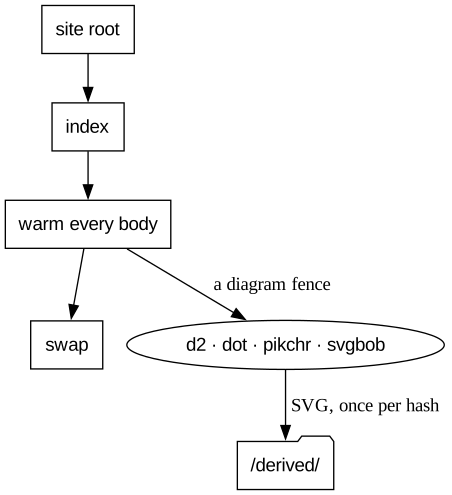
A fenced block in a diagram language is drawn rather than shown: the engine hands the source to the program that language belongs to, keeps the SVG it answers with, and the page shows the picture (khosra ADR-0391). Four languages, four programs, each optional — the host decides which are installed:
| Fence | Program | Good at |
|---|---|---|
```d2 |
D2 | boxes and arrows laid out for you, with labels and containers |
```dot |
Graphviz | graphs: dependencies, state machines, anything with many edges |
```pikchr |
Pikchr | a line drawing placed by hand, the way pic placed them |
```svgbob |
Svgbob | ASCII art turned into clean lines — it reads well even undrawn |
Each drawing is made once, when the site is rebuilt, and kept under /derived/ named by a hash of its source:
an unchanged diagram is never drawn again, and no reader ever waits on a program. A fence the host cannot draw —
the program is not installed, or it could not read the source — is shown as the code block it is, and
khosra check says which and why.
D2

Graphviz
From a file beside this page, with file= — the same option any fence takes, so one diagram can sit in several
posts and stay one file:
Pikchr

Svgbob
Placed
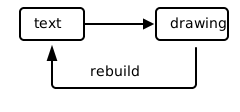
A drawing sits where a picture can, by the same words after the fence’s language — marginal, runaround-right, plate.

marginal hangs a small drawing in the margin beside the paragraph it was written next to, the way a picture or a
side note does. Below the width that has a margin it comes back into the column, small and centred. The words around
it keep their own measure; the drawing does not push them aside.

runaround-right floats the drawing beside the text, the words running round it for as long as it lasts and then
taking back the full width of the column. A drawing taller than the paragraph beside it keeps the next one running
round it too, which is usually what a reader expects of a figure set into the text.

A drawing is never drawn larger than it was made: plate gives a wide one the room to be its own size, and leaves a
small one as it is.
Not a diagram
Every other language is highlighted as code, exactly as before — a fence is drawn only when its language is one of the four above:
func main() { println("still code") }
Subscribe
Readings go up when the gauge has been read, not on a schedule: most weeks twice, every day in the monsoon. However you follow, nothing about you is kept here.
- In a feed reader
- Atom · JSON Feed. Each section has a feed of its own, at its address followed by feed.xml.
- In the fediverse
- Search for https://adventure.x.bdeshi.space/ in Mastodon or any other fediverse app, and follow it.
- From your own site
- Follow https://adventure.x.bdeshi.space/ in an IndieWeb reader. A reply, like or repost from your own site reaches the post here by webmention.